
VeSPoTec at the AMC Annual Conference 2024
Organized by the Alva Myrdal Centre for Nuclear Disarmament, the event aimed to foster collaboration and innovative solutions to advance nuclear disarmament. Thus, the conference gathered experts from various disciplines to discuss the urgent need for renewed efforts in arms control and non-proliferation amidst a challenging global landscape.
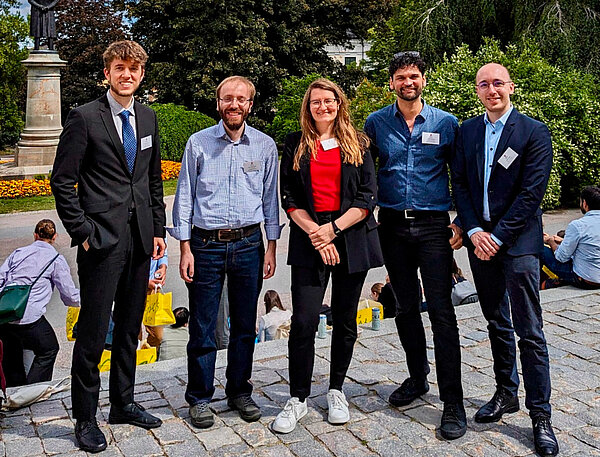
During the Conference, the VeSPoTec delegation presented five projects that are currently being worked on within the VeSPoTec consortium:
1) Technology, Knowledge and Verification: How the IAEA develops and implements new technologies for nuclear verification
The International Atomic Energy Agency (IAEA) is one of the most important pillars in ensuring that nuclear materials are used solely for peaceful purposes through its verification process. This also involves adopting new technologies to stay effective and efficient. However, integrating innovations into the IAEA’s verification regime can be challenging due to regime-specific resistances. The research of Julian Schäfer explores how the IAEA scans the technology landscape and communicates its needs to the research community. By using the multi-level perspective framework, the study aims to provide a social science perspective on the diffusion of technology, highlighting the complex socio-technical process faced by the IAEA.
2) The IAEA and Irreversible Nuclear Disarmament: Challenges and Opportunities.
The presentation of Leonardo Bandarra delved into the complex interplay between trust and verification in international nuclear commitments, emphasizing the crucial role of nuclear inspectors. It addresses how inspectors perceive and establish trust through their verification activities. Through a three-phase qualitative approach – comprising (1) content analysis of reports and testimonies, (2) an online survey of current inspectors, and (3) a focus group with retired inspectors – the research uncovers detailed insights into the dynamics of trust and verification.
3) Reconstructing nuclear histories with reactor-archive documents
Future arms control and disarmament agreements will likely require verification of fissile material declarations from nuclear-armed states. To ensure these declarations are accurate and complete, understanding the historical production of fissile material is important. This is where nuclear archaeology, approaches to reconstruct historical fissile material balances, comes into play. Traditionally, this involves forensic measurements at former production sites, but operational documents from these facilities can also provide valuable information. The presentation and conference paper by Sophie Kretzschmar & Lukas Rademacher explored this document-based nuclear archaeology approach by examining archives from the FR-2 and MZFR reactors in Karlsruhe, Germany.
4) Nuclear archaeology for disarmament verification – an integrated interdisciplinary Approach
As seen above, nuclear archaeology offers a promising approach for the verification of fissile material declarations. However, this method faces practical limitations due to uncertainties and information gaps. By viewing verification as both a technical and a socio-political process, a more comprehensive understanding can be achieved. The presentation and conference paper by Sophie Kretzschmar & Linda Ostermann combines insights from physics and sociology to elucidate the role of nuclear archaeology in disarmament verification, highlighting the complex interplay of technologies, actors, institutions, and practices in producing knowledge for political decision-making.
5) Exploring Nuclear Verification through Expert Discussion – A Field Report
Lukas Rademacher presented insights from two VeSPoTec verification exercises: First, in September 2023, a workshop at the ‘Science Peace Security ‘23’ conference used a world café format to discuss restoring confidence in nuclear safeguards during crises like terrorist occupations, natural disasters, and regime changes. Second, in December 2023, a two-day tabletop exercise brought safeguards experts together to analyze information relevant to state evaluations by the IAEA. Through role-playing, experts together with VeSPoTec members examined the availability and reliability of various information types under different safeguards agreements and scenarios.
If you are interested to learn more and have a look at the respective internal conference papers, please feel free to get in touch.