
VeSPoTec at the 55th “AFK-Kolloquium” of the German Association of Peace and Conflict Studies
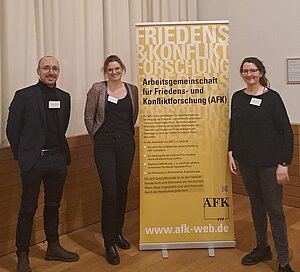
How does verification technology diffuse from the niche of research & development into the IAEA’s verification regime? And which actors are involved? Julian Schäfer presented his initial findings based on interviews that he has conducted with experts from the National Labs in the United States and representatives of the IAEA, as well as the theoretical background of his PhD project to the peace and conflict experts.
Linda Ostermann and Sophie Kretzschmar then presented their joint research idea, an interdisciplinary approach to understanding how the remaining uncertainties of nuclear archaeology in disarmament verification can be understood in a more holistic perspective, based on interactions between experts, different approaches to interpreting and contextualizing information gathered in verification activities, and diplomatic practices.
In addition, Andreas Dürholt shed a light on the role of the third player in a game theoretical approach to understanding and explaining the jeopardies of a nuclear proliferating Iran.
Linda Ostermann and Julian Schäfer, as spokespersons and representatives of young researchers within the association, and building on a web series on the topic that they had organized in advance, also held a meeting to discuss how to promote the implementation of security-related perspectives in the teaching of STEM courses at universities, such as reflections on dual-use options.
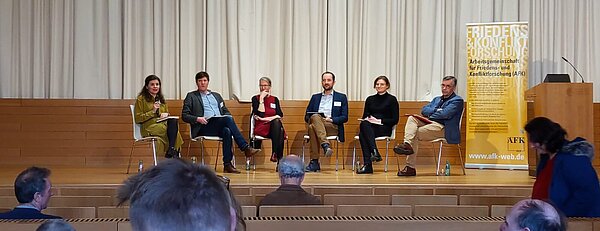
Malte Göttsche and Linda Ostermann also participated as speakers in a panel discussion on new challenges for peace and conflict research in a state of global polycrises and the interdisciplinary complexities of dealing with them. Moderated by Madita Standke-Erdmann, they discussed with Christian Reuter, Claudia Brunner and Christopher Daase the origin and history of scientific-technical peace and conflict research in Germany, its current state and how it should or could develop in the future, taking into account the implementation of interdisciplinarity in university courses.
We returned to Aachen with new productive inspiration, very valuable feedback and new ideas for cooperation. We look forward to participating and presenting again next year.