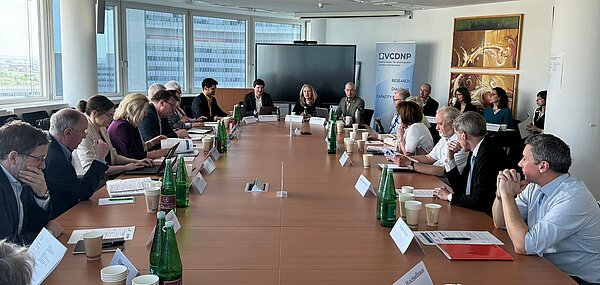

On 8 April 2024, the research consortium VeSPoTec (Verification in a Complex and Unpredictable World: Social, Political and Technical Processes) and the Vienna Center for Disarmament and Non-Proliferation (VCDNP) held a workshop focused on the potential role of the International Atomic Energy Agency (IAEA) in verifying the irreversible reduction and elimination of military nuclear stockpiles. Participants included senior former and current practitioners from the field of nuclear verification and international safeguards. In addition to guided discussions, invited experts participated in a simulated negotiation in which a fictitious, formerly armed State was accused of reconstituting its nuclear weapons programme. Some of the main takeaways from the workshop are listed below.
Which body should verify nuclear disarmament?
During discussions, many participants cited the IAEA as a logical choice to be involved in disarmament verification, particularly in the verification of nuclear material from nuclear weapons programmes without classified characteristics, or the dismantlement or monitoring of relevant nuclear fuel cycle facilities. Others highlighted that adding new activities to the IAEA could generate challenges, including exacerbating the IAEA’s existing resource constraints. Participants also cited the potential for internal cultural tensions within the IAEA: would there be “regular inspectors” for non-nuclear-weapon States and a separate cadre of inspectors for formerly nuclear-armed States?
Most participants agreed that the way in which a nuclear-armed State disarms will affect how verification is conducted. South Africa was referenced as a case in which the IAEA verified the absence of a nuclear weapons programme only after disarmament had occurred unilaterally. Others suggested the need for a new institutional framework – either a new organisation or a multilateral framework – to assist and oversee disarmament.
How would disarmament verification be resourced?
Participants agreed that, regardless of which body verifies disarmament, an increase in the resources currently allocated for nuclear verification will be required. Should verification be conducted by the IAEA, the Agency would require a significant budget increase. It could be in the form of a regular budget increase, an extrabudgetary fund created for nuclear disarmament verification (like the Nuclear Security Fund), or an agreement that specifies the IAEA as the verification body to which parties would contribute (like the Joint Comprehensive Plan of Action). It could also be a different model altogether.
Even if the IAEA were not to play an active role in verifying nuclear disarmament, in a disarming world it would still need to significantly increase the staff of the inspectorate to account for the large increase in nuclear material that would become subject to safeguards in formerly nuclear-armed States. The view was also expressed that if there were to be a safeguards budget separate from a disarmament budget in the IAEA, great care would have to be taken so that they did not become entangled.
How much could be verified, and what is sufficient for former nuclear-armed states?
Participants agreed that “100 percent verification” is impossible, even in the best of verification circumstances, but particularly in verifying the disarmed status of a State, owing to the need for efficiencies in verification and the large scale of current nuclear-weapon States’ nuclear programmes. For these reasons, it would be unlikely that the IAEA would be able to draw conclusions for disarmed States about the completeness of declarations in the near and medium terms. The IAEA would also likely continue to be constrained from directly accessing any material with classified characteristics, though several participants noted the Trilateral Initiative as an example of the IAEA working collaboratively with States to provide “sufficient confidence” that nuclear material with classified characteristics met certain thresholds in isotopic composition and mass and was then placed under safeguards.
Several participants noted that the universalisation of additional protocols to safeguards agreements would be a stabilising factor in a world where most or all States have disarmed. There was some discussion as to whether an additional legal instrument with tailored provisions for non-compliance would need to be concluded by formerly nuclear-armed States. Some participants noted that such an instrument would be highly dependent on the context in which States disarm and the technology available.